❌

阅读视图

🔲
☆

Nvidia Halts AI Server Shipments to Four Southeast Asian Countries

(本文作者为 Chelsea_Sun,钛媒体经授权发布)

TMTPOST — The world's chip giant Nvidia has told its manufacturing partners to stop shipping servers that contain its chips to Malaysia, Singapore, Thailand and Indonesia, according to Financial Times.

Buyers in those countries have been informed that pending orders will not ship for now. Dell and Super Micro Computer, which build finished systems around Nvidia processors, are among the partners that notified customers. Nvidia, Dell and Super Micro did not immediately respond to requests for comment. It remains unclear whether the halt is temporary while the companies work through new compliance requirements.

The freeze follows an interim final rule from the U.S. Commerce Department’s Bureau of Industry and Security, published in mid-November and effective days later. The rule requires licenses for the export, re-export or transfer of certain advanced computing chips to Singapore, Malaysia, Thailand, Indonesia and Brazil. Operators of existing data centers that serve covered customers were given about 90 days—into mid-February—to obtain licenses. Reporting has indicated that chips destined for end users headquartered in the United States fall outside the same restriction.

Washington has long limited direct shipments of Nvidia’s most advanced accelerators to China. Chinese developers responded in part by renting capacity from cloud and data-center operators in Southeast Asia and accessing the hardware remotely. The latest rule is designed to close that route by placing both physical deliveries into the region and large-scale remote access under licensing review.

Southeast Asia had become one of the fastest-growing markets for AI data-center investment, drawn by power, land and connectivity—and, for some tenants, by access to restricted silicon. The corridor is commercially important to Nvidia. Company accounts show the chipmaker booked about $104 billion of revenue through its Singapore subsidiary in 2025, a 72% increase from a year earlier, though that figure also includes some sales linked to Taiwan and China that are recorded through the same unit.

Server partners are absorbing the first shock. At least two Nvidia partners paused shipments to Southeast Asian customers around the rule’s effective date. One executive told Nikkei Asia that the firm had stopped taking new orders from the region and was concerned about holding expensive GPU boards in inventory. Trade coverage has put flagship Grace Blackwell GB200 NVL72 racks near $5 million and individual Blackwell B200 GPUs near $500,000, levels that make idle stock costly.

Financing is under strain as well. Reporting tied to the Financial Times said banks had paused roughly $500 million in credit lined up for Singapore cloud firm Aolani, which had planned to supply advanced capacity under arrangements linked to ByteDance. Cloud operators have said the rule started a compliance clock without clear guidance on how to apply for licenses, leaving projects caught between frozen hardware and a running deadline.

For Nvidia, the immediate issue is disruption in the channel rather than a proven collapse in demand. The company has said global demand for its accelerators still exceeds supply and that volume can often be redirected. That assumes other buyers take systems once earmarked for Southeast Asian facilities, and that licensed paths reopen for customers who can document acceptable end use. Neither is guaranteed. Delay stretches the time it takes server makers to convert record AI backlogs into revenue and raises the cost of capital for data-center developers who can no longer treat GPU delivery as a fixed schedule.

The larger change is what regulators now treat as the controlled item. Export policy long focused on where a chip was shipped. The new framework also asks who may use large pools of computing power after the servers are installed.

Southeast Asia’s data-center buildout is unlikely to stop. Its economics will change as major rack orders and large remote-tenancy contracts must clear a licensing process that is still being interpreted in real time. Until that process becomes routine, AI infrastructure in the region will be priced not only for power and land, but for regulatory risk.

更多精彩内容,关注钛媒体微信号(ID:taimeiti),或者下载钛媒体App

  • 🔲
  • ☆
  •  
🔲
⭐

ByteDance's Short-Video Platform Hongguo Forces Second-Tier Platforms to Bet on AI

TMTPOST -- With the release of China's video platform Bilibili's Q3 financial report on Tuesday, the Q3 earnings season for second-tier internet companies officially came to an end.

Looking only at Bilibili’s “grand finale” earnings report, it’s easy to get the illusion that the industry is warming up: in Q3, Bilibili’s revenue grew 8% year on year, with advertising revenue surging 20% and accounting for more than 80% of the quarter’s incremental revenue. Average daily time spent per user broke the two-hour mark for the first time, reaching 121 minutes. Among China’s second-tier platforms where core businesses were under pressure, Bilibili stood out as the only exception, with revenue and ad growth rates nearly matching Tencent’s over the same period (8% revenue growth and 19% growth in marketing services).

But once you peel back the surface of growth, Bilibili’s underlying concerns are just as plain to see: its ad growth has slid for three straight quarters, from 30% in Q1 and 28% in Q2 to 20% this quarter. On a per–daily active user basis, Bilibili’s Q3 ad revenue per user was only about RMB 25, less than 60% of Kuaishou’s (about RMB 43). Even more glaring is the paid-user side: even on Bilibili, which has one of the stickiest communities, the number of premium members shrank from 25.40 million a year ago to 24.68 million.

Zooming out from Bilibili to the broader batch of second-tier internet companies that posted results over the past week reveals a decidedly grim industry picture: Kuaishou’s Q3 revenue fell 11.1% year on year, iQIYI fell 10%, Beike fell 8.9%, Weibo fell 7%, and even NetEase—long known for its steadiness—posted negative growth of 1.8%.

Users haven’t left these platforms; on paper, traffic is still growing. In Kuaishou’s third quarter, daily active users (DAU) reached 417 million, and its earnings report still touted it as an “all-time high.” But a closer look tells a different story: Kuaishou’s DAU grew only 0.3% year over year, while monthly active users (MAU) rose 12%. In other words, more people have Kuaishou installed on their phones, but not many more are opening it every day. Its DAU-to-MAU ratio (DAU/MAU) slid from 57% a year ago to 51%, and revenue per DAU fell from RMB 85.5 to RMB 75.7—a drop of more than 10%.

This is the reality facing the entire “second-tier” internet sector in Q3 2026: users are still there, but they’re opening the apps less often, and each user is generating less monetization value. Squeezed on both sides—by Tencent siphoning ad budgets through WeChat’s closed-loop transaction ecosystem, and by ByteDance using free content to undercut users’ willingness to pay—second-tier internet companies are losing pricing power on both the advertising side and the user side at the same time.

Advertisers Reshuffle

The revenue slowdown at second-tier platforms first stems from a dramatic reshuffling of their advertiser mix.

A look through Weibo and Kuaishou’s earnings reports shows traditional high-margin advertisers pulling back. Weibo’s industry breakdown indicates that ad contributions from its three pillar sectors—e-commerce, online games, and beauty/cosmetics—all declined year over year, with increases only in internet services, mobile phones, and automobiles. Ad revenue from Alibaba plunged 33%; Weibo CEO Wang Gaofei attributed this to a high base in the prior-year period caused by the food-delivery price war. Kuaishou’s online marketing services revenue also fell, down 11.1% to RMB 17.9 billion. CFO Jin Bing explained that intensified competition in e-commerce led merchants to rein in marketing spend.

Filling the gaps were short dramas and AI apps. As of September, the average number of daily active short dramas on Kuaishou had surged by more than 350% compared with this January, and marketing spend from the content-consumption sector more than doubled year over year. Bilibili’s AI-industry ad placements in the third quarter also jumped nearly 95% year over year.

But the commercial value that the old and new waves of advertisers bring to platforms is fundamentally different. In the past, e-commerce and beauty clients valued “integrated branding and performance,” with transactions often completed within the platform or through tightly linked funnels. Because platforms could track final purchase data, they had the confidence to charge premium prices based on conversion results. Today, however, short dramas and AI apps that are flooding in follow a pure user-acquisition (“buying traffic”) logic: after a user clicks an ad, they jump directly to an external app or mini program, and everything that happens afterward—top-ups, retention, and repeat purchases—has nothing to do with the second-tier platform.

Without access to downstream conversion data, second-tier platforms can only collect a one-off “toll” in the form of clicks or activations in these deals. UA teams watch real-time ROI models every day and price-shop across the entire internet, buying wherever traffic is cheapest; platforms have virtually no room to negotiate. This is also the crux of Kuaishou’s “record-high DAUs, yet declining revenue”: it wasn’t selling less ad inventory—it was selling fewer high-priced closed-loop ads and more low-priced, volume-driven UA ads.

Even though both are tapping into short-drama ad budgets, what Tencent earns is the money from the entire chain. In the third quarter, Tencent’s marketing services revenue reached 43 billion yuan, up 19% year on year. Beyond AI improving ad targeting and content recommendation efficiency, the key driver was that short dramas and WeChat Shops made the transactional closed loop work within the WeChat ecosystem. Tencent not only sells ad slots; it also stepped in to procure short-drama content itself, keeping UA spend, user top-ups, and content distribution all locked inside the WeChat system (as a result, Tencent marketing services’ gross margin also fell from 57% to 52% as AI operations and short-drama content costs rose).

This gap in data closed loops is being widened further by AI. Today’s ad delivery systems rely heavily on real transaction conversion data to train models. Tencent and ByteDance control payment and end-to-end transaction loops, so every purchase feeds back into the algorithms—the more accurate the targeting, the higher advertisers bid. By contrast, even if second-tier platforms plug into equally advanced large models, they still can’t capture conversion signals from the transaction end. Weibo only began promoting AI-powered delivery tools toward the end of the third quarter; what it really lacks isn’t algorithmic tooling, but the transaction data needed to feed the models.

By the fourth quarter, there was still no sign that this pressure was easing. Wang Gaofei expected that the high base from last year’s fourth-quarter food-delivery price war and the AI marketing boom would continue to weigh on Weibo’s year-on-year performance. Kuaishou, in a rare move, even admitted bluntly in its earnings report that “our traffic trends have weakened.” When a company whose DAU is still hitting new highs says that, it means the current scale of traffic can no longer sustain the bids advertisers are willing to pay.

Free Short Dramas Disrupt Dynamics

As pricing power on the advertising side slips away, several core businesses through which second-tier internet companies directly charge consumers—long-form video subscriptions, games, and livestreaming—also hit the brakes at the same time in the third quarter.

You can feel the chill just by looking at a string of earnings figures: iQIYI’s third-quarter subscription services revenue was RMB 3.97 billion, down about 6% year on year; NetEase’s revenue from games and related value-added services was RMB 22.9 billion, down 1.7% year on year—its first year-on-year decline since Q3 2024; livestreaming was hit even harder, with Kuaishou’s livestreaming revenue plunging 19%, Huya down 4.3%, and Tencent Music’s social entertainment business continuing to shrink.

The single biggest variable shaking up the industry has been ByteDance’s Hongguo Short Drama.

According to an earlier report by 36Kr, Hongguo’s revenue had already surpassed RMB 5 billion in the first quarter of this year. QuestMobile data showed that by July this year, Hongguo’s daily active users had reached 168 million, exceeding the combined DAU of the four major long-video platforms—Tencent Video, iQIYI, Youku, and Mango TV—with average time spent per user as high as 125 minutes per day.

Hongguo is completely free for users and monetizes through rewarded ads, bespoke brand partnerships, and embedded e-commerce. ByteDance dares to drop the content price straight to zero because its massive ad engine can squeeze enough ad revenue out of every minute users spend to cover content costs—and even earn more than peers that work hard to collect subscription fees from users.

When a flood of free, highly satisfying content fills up users’ entertainment time, long-video subscriptions and heavy, time-consuming games that used to require payment naturally face a crowding-out effect. NetEase CEO Ding Lei also acknowledged publicly on the third-quarter earnings call that short dramas are competing extremely aggressively for user attention and, in the short term, have indeed diverted traffic away from the games business.

The most symbolic move came from Tencent Music. After its revenue growth rate slid from 20.6% in Q3 2025 to 5.6% this quarter, Tencent Music announced that starting in 2026 it would no longer disclose, on a quarterly basis, the number of paying online music users or ARPPU (average revenue per paying user).

Over the past few years, the reason capital markets assigned Tencent Music a premium valuation was the long-term growth thesis of “paying-user growth × ARPPU uplift.” Now, with the company proactively suspending quarterly disclosure, it is effectively an acknowledgment that this growth story has become hard to sustain at the previous pace.

Put the advertising side and the user side together, and you get a dispiriting loop that many second-tier internet companies can hardly avoid: on the one hand, free short dramas are spending aggressively on Kuaishou and Weibo to buy traffic, becoming one of the few ad buyers still delivering high growth for second-tier platforms; on the other hand, they then use that purchased traffic to siphon off user time at scale from ecosystems like iQIYI, NetEase, and even Kuaishou’s own. A significant share of the incremental ad revenue these second-tier platforms earn is, in effect, ammunition that competitors use to poach their users.

Cutting Costs, Betting Big on AI

As growth in their core businesses stalled, most second-tier companies in Q3 shifted their focus to cost reduction, efficiency gains, and shareholder returns.

Beike’s Q3 gross transaction value (GTV) rose 4.5% and net revenue fell 8.9%, but by tightly controlling expenses, net profit surged 193.9% year over year; iQIYI cut content costs by 13%, barely managing to maintain adjusted operating profitability. Huya posted its first operating profit since Q3 2022. NetEase, meanwhile, lifted its gross margin from 64.1% to 68.3% even as game revenue edged down.

The hard cash they saved was largely funneled into buybacks to shore up share prices. In the third quarter, Tencent Music repurchased about $300 million of stock; Bilibili completed a $300 million special repurchase program and retired all the shares; Kuaishou bought back roughly HK$1.41 billion; and Huya also repurchased about $13.7 million. In the eyes of the secondary market, these companies are being re-positioned—from growth stocks once valued for their expansion narratives—to value stocks now judged on cash flow strength and dividend payout potential.

But there is a ceiling to squeezing profits by cutting costs. In the third quarter, iQIYI’s non-GAAP operating profit was only 25 million yuan; against total revenue of 6.01 billion yuan, that puts its operating margin at under 0.5%. Costs can be pressed down again and again, but as long as top-line revenue can’t stop sliding, margins will quickly hit a hard cap.

If they’re not willing to stay purely on defense, the other path is to bite the bullet and spend big on AI. In the third quarter, Kuaishou opted for an aggressive push: quarterly R&D expenses jumped 41.9% to 5.2 billion yuan, with most of the funds flowing into the Kling foundation model. That level of investment punched straight through the income statement: Kuaishou’s overall operating profit swung from a 5.3 billion yuan profit a year earlier to a 635 million yuan loss, while operating profit for its domestic segment plunged from 5.4 billion yuan to 420 million yuan.

Put Kuaishou’s numbers next to Tencent’s, and the brutality of the gap in scale becomes clear. According to media estimates, in the third quarter, new AI products such as Yuanbao and WorkBuddy dragged down Tencent’s operating profit by about 15.2 billion yuan. But even after stripping out that massive investment, Tencent’s operating profit for the quarter still rose 8% year over year, reaching 83.3 billion yuan. The amount Tencent burned in a single quarter on new AI applications was more than thirty times Kuaishou’s entire operating profit from its domestic business.

For second-tier companies competing with giants in AI, what they lack isn’t determination—it’s the ability for their core businesses to “feed” AI with cash. Although Kuaishou’s Kling and Wanqing have already started contributing revenue independently, and iQIYI has around 20 long-form series in production using a “live-action + AI hybrid workflow” to cut production costs, these scattered commercialization gains are still far from enough, once placed into the full financial statements, to plug the hole left by the decline of their traditional core businesses.

Since they can’t keep burning cash on their own, turning to first-tier big tech companies for leverage has become a third way out. This quarter, two landmark capital moves have already sketched out a new set of industry relationships:

First, Kuaishou’s Kling brought in external financing at a post-money valuation of about US$18 billion, with Tencent, Alibaba, and Baidu—the three major giants—all joining the round. Second, Bilibili issued US$700 million in zero-coupon convertible notes in September; one of the stated uses of proceeds was to enhance its AI capabilities for content understanding, recommendations, and creation. In that transaction, Tencent subscribed for US$200 million of the notes, while Bilibili used US$200 million in cash to repurchase Tencent’s existing shares (with another roughly US$400 million of existing shares placed in the secondary market).

Between the inflow and the outflow, Tencent effectively swapped part of its Bilibili common stock holdings for US$200 million in cash plus a five-year convertible note. For second-tier companies, doing AI without a sufficient profit cushion makes independent fundraising or issuing debt a way to address urgent needs. For first-tier giants, they don’t want to take on the burden of second-tier companies’ heavy financial statements through full acquisitions; by contrast, convertible notes and minority stakes in subsidiaries can both lock in early chips in high-quality content and the AI track, while preserving a safety buffer for their capital. Deals like this are likely to show up frequently going forward—but the cost is also obvious: the strategic independence of second-tier platforms is being diluted step by step.

Hold on to User Time

Even amid broad weakness, the Q3 reports still reveal a handful of the few high-growth businesses. Once you categorize them, it becomes clear that the businesses doing well have largely avoided head-on attrition with Tencent and ByteDance in China’s domestic traffic pool.

The most straightforward way to steer clear is to go global. JOYY’s third-quarter revenue rose 15.6% year over year, with its overseas advertising platform BIGO Ads surging 39.6% in revenue; non-livestreaming revenue has already climbed to 32.8% of the total. iQIYI’s domestic base shrank, but its overseas membership revenue still grew by nearly 30% year over year. Kuaishou’s operating loss from its overseas business also narrowed 64.1% year over year. Bilibili’s self-developed game Shining! Lummi, which launched globally in September, was already getting close to half of its revenue from overseas by the end of October. In overseas markets, second-tier companies at least don’t have to contend head-on with Tencent and ByteDance’s dual monopoly over distribution channels and budgets.

In the domestic market, the only thing still capable of holding back the erosion from free, algorithm-driven offerings is differentiated experiences you can’t find on Douyin, Hongguo, or Soda Music.

Tencent Music is a textbook example. ByteDance’s Soda Music can use “free” and algorithmic recommendations to poach casual, light users who just want to listen to a few songs—but it can’t take away die-hard fans who are willing to pay for concert tickets and physical merch for their idols.

In the third quarter, Tencent Music’s revenue from marketing and consumer services grew against the trend, up 12.1% to RMB 2.7 billion, driven primarily by artist merchandise and offline performances. Turning the “traffic business of listening to songs” into “fan spending for idol-chasing” is the key to sidestepping the shock of free music. The same logic also shows up at Huya and NetEase: Huya has been pushing harder into self-run esports tournaments and game publishing, while NetEase has placed a big bet on Infinite, a new anime-style open-world title scheduled to launch on January 15, 2027, which had already surpassed 27 million pre-registrations across the web. As Ding Lei repeatedly emphasized on the earnings call, the deep interactive experience of “control and feedback” in games is something short videos and short dramas can never replace.

That’s also why Bilibili was able to deliver the only high-growth report card in the third quarter.

Bilibili’s average daily usage time of 121 minutes was roughly on par with Hongguo short dramas (125 minutes), but the underlying assets are entirely different. In the third quarter, time spent consuming AI and knowledge-oriented content on Bilibili more than doubled (+108%); the average daily volume of uploads by creators (UPs) rose 36%, average income per UP increased 25%, and revenue from IP-derived products and other sources driven by this ecosystem also grew 15%. It is precisely this community trust built around specialized creators and deep content that has led AI companies to treat Bilibili as a core battleground for product reviews while also pouring large ad budgets into the platform—and it has also meant that ordinary users, even as they have become less willing to casually renew platform-wide premium memberships, are still willing to pay for specific creators, specific IP merchandise, and products endorsed by those creators.

In Q3, Bilibili’s home & home improvement and footwear & apparel ad categories surged by 51% and 39%, respectively. During the Double 11 shopping festival, over 90 million users watched branded content and engaged with it on Bilibili, and the share of new customers delivered to partner brands exceeded 55%.

That said, even Bilibili—the strongest performer—has now reached the point where it must prove its ability to convert interest into transactions. Its rapid growth over the past few quarters was, to a large extent, a catch-up sprint to make up for its historically low monetization efficiency. As ad growth has gradually cooled from 30% down to 20%, the easy gains from simply extending time spent and increasing ad load are hitting their ceiling.

Management specifically highlighted Double 11’s new-customer conversion figures, along with growth in transaction-heavy categories such as home & living and footwear/apparel, in the earnings report—showing Bilibili understands this very clearly: its distinctive community positioning has helped it avoid becoming a bargain-basement, performance-buying channel, but if it wants to keep lifting ad output beyond RMB 25 per DAU, it ultimately needs to plug into a conversion path that lets brands see real sales results.

Over the past decade, valuing a second-tier internet company was straightforward: DAUs multiplied by monetization per user. As long as the user base was big enough, there was always some premium to be had.

But this batch of Q3 2026 earnings reports signaled the end of that old logic. When Kuaishou posted a record-high 417 million DAUs yet still saw an 11% revenue decline, while Bilibili—whose DAUs are less than 30% of Kuaishou’s—still managed 20% ad growth, the market had already drawn a new line in the sand: if you can’t offer a distinctive content experience beyond what algorithms hand out for free, and you also can’t help advertisers achieve real transaction conversion, then no matter how massive your DAU figure is, it ultimately becomes nothing more than cheap traffic feeding the ecosystems of the giants.

更多精彩内容,关注钛媒体微信号(ID:taimeiti),或者下载钛媒体App

  • 🔲
  • ⭐
  •  
🔲
☆

After Novelty Wears off, How can Companion Robots Actually be Put to Use?

NextFin News -- At Germany’s IFA show, the OlloBot team noticed that some kids figured out OlloNi’s touch-sensitive zones in just five to ten minutes—then they named it, talked to it, and even offered it their snacks.

Kids’ curiosity is easy to spark. The harder question is how robots enter the home and keep getting used—rather than ending up left in a corner, gathering dust.

LOVOT is a leading example of a cute, pet-like companion robot. GROOVE X has disclosed that from its launch in December 2018 through the end of June 2026—a span of seven and a half years—LOVOT recorded about 20,000 active contracts.

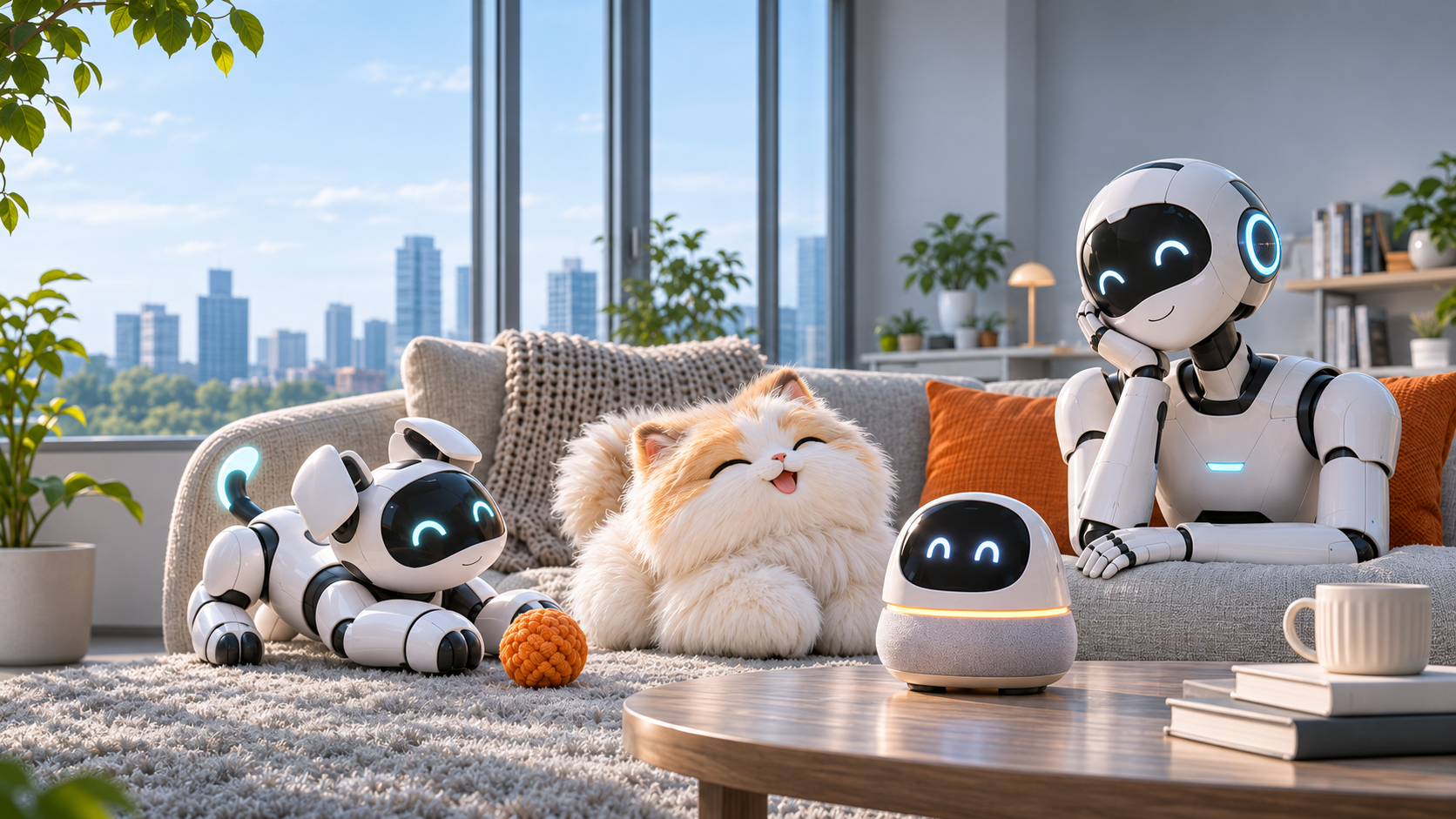
This year, a wave of companion robots in very different forms poured into the track: cyber pets that can walk around on their own, plush toys you can hug, and full-size humanoid robots with synthetic skin.

On June 30, UBTECH’s UWorld released the U1 series of full-size companion robots; in July, Xinyan Group’s robot “Babu” made its first public appearance at WAIC 2026; and in September, pet-style companion robots such as Woan’s KATA Friends and Huichang Technology’s OlloBot debuted at IFA.

Unlike embodied-intelligence products that compete on their ability to do chores, these products rarely pitch household-task capability as the selling point. Instead, they focus on emotional interaction, entertainment, tactile experiences, and in-home care—hoping these “soft services” will earn them a lasting place in the household.

Six Different Types of Buyers

Under the umbrella of “companion robots” sit product types whose needs and capabilities vary widely.

There isn’t a single, universally accepted taxonomy. Based on the core reasons people buy them, they can roughly be grouped into six categories: cute, pet-like emotional companionship; entertainment and interactive toys; child development and education; care and safety monitoring; multi-purpose; and humanoid companionship.

Among these, cute, pet-like emotional companionship is where innovation has been especially concentrated. Japan’s LOVOT, Sony’s aibo, and Casio’s Moflin—as well as China’s OlloBot, KATA Friends, Babu, Loona, Ropet, and others—all aim to build long-term relationships with consumers through pet-like form factors, emotional feedback, and “personality” development over time.

The differences in form factor and cost are stark. Moflin and Fuzozo create a sense of companionship through a plush touch, sounds, and simple movements; LOVOT, OlloBot, and similar products require autonomous mobility, environmental perception, and motion control.

Entertainment and interactive toys—represented by Eilik and EMO—focus on character design, facial expressions, and game-like interactions. In the growth-and-education space, there are products such as Miko and Moxie. Care and companionship for seniors includes ElliQ and Hyodol, as well as PARO, an assistive therapeutic robot.

Shangwei New Materials’ Qiyuan and Songyan Power’s Xiaobumi, among others, take a compact, playable, and modifiable approach—combining companionship with programming education, content creation, and embodied operation—placing them in the designer-toy and platform category. Humanlike companionship is another direction many embodied-intelligence companies have been betting on, developing ultra-bionic humanoid robots positioned around emotional companionship, such as UBTECH’s You World U1 series and Realbotix’s humanlike companion robot Aria in the U.S.

Different routes reflect different views on how families and robots should build relationships.

Fang Yilin, General Manager of Huichang Technology and CEO of OlloBot, told Chuhai Cankao that “when the team first considered a home-robot product, we believed there was still a long technological distance to go before robots could handle complex household chores, while simple AI toys are easily left unused after the initial short-term novelty. So in the end we chose a more family-friendly cyber pet as our entry point.”

This has also become a common choice in today’s home-robot industry: when household-labor capabilities are not yet mature, companies try to get robots into homes first through companionship.

Beyond differences in product route, attitudes in the capital markets have also shifted.

When the market was hot, both new entrants and capital poured in. According to statistics from IT Juzi, in the first half of this year the domestic embodied-intelligence track saw RMB 93.5 billion in financing across 322 deals—about five times the amount in the same period last year (companionship is not tracked separately for now, so cross-industry embodied-intelligence data is used as a reference). The companionship direction also received a share: Luobo Intelligence completed a Pre-A round of over RMB 100 million early this year; SoulX secured tens of millions of RMB in angel investment from GL Ventures.

As the third quarter began, the pace of capital slowed. Citing a roundup by Yicai, disclosed embodied-intelligence financing in Q3 2026 totaled about RMB 33.3 billion, lower than the roughly RMB 46.7 billion per quarter average in the first half of the year. Using that first-half quarterly average as a benchmark, the number of deals Sequoia China participated in fell from about 10 to 8, while Hillhouse Ventures dropped from about 9 to 4.

On the one hand, there’s less money; on the other, where it goes has become more concentrated. Data from ITjuzi shows that in the first half of the year, around 70% of funding flowed to the top 20 companies. Firms in the second and third tiers are finding it hard to secure fresh funding. Back to companion products: after researching AI companion toys, one investor said that “the ongoing experience of some (non–top-tier) products is pretty average.”

One of the criteria Sequoia China Managing Director Li Yannan offered is this: whether an AI hardware product is worth investing in hinges on whether the device can proactively sense its environment, understand information, and respond accordingly—it can’t remain stuck at the stage of merely waiting for users to issue commands.

With Curiosity Gone, What Keeps Companion Robot Relevant?

At IFA, a child’s curiosity for a few minutes is only the trigger point; the real challenge is how a companion robot can be switched on frequently and used by families over the long term.

Fang Yilin told Chuhai Cankao that OlloBot focuses more on steady interaction over 7 days, 30 days, 90 days, and even 360 days. To increase engagement, OlloBot is designed for proactive interaction, having the robot approach its owner and other family members on its own—like a pet would.

To fit the “pet” positioning, OlloBot doesn’t answer questions directly in human languages like Mandarin or English the way most AI assistants do. Instead, it has created a unique “electronic pet” language of its own. Users need to infer meaning from its sounds, movements, and the expressions on its screen, gradually becoming familiar with its personality.

Fang Yilin explained: “The team seriously debated whether to let the robot speak human language directly, but if a pet turns into an assistant that answers every question, it loses what makes it a pet. Users need to actively explore and understand the robot in order to form a relationship that’s different from using ordinary smart devices.”

Japan’s LOVOT has also been trying to build long-term interaction through proactive approach behaviors, body warmth, tactile feedback, and behavioral changes. Woan’s KATA Friends, meanwhile, emphasizes autonomous mobility, proactive interaction, and remembering family members.

All of these designs aim to ensure that robots no longer can only wait passively to be “woken up” by users. But as proactive interaction becomes a shared capability of more and more companion robots, a new challenge emerges: how to strike the right balance between being proactive and being intrusive.

Fang Yilin told us that OlloBot chooses when to initiate interaction based on the owner’s daily habits, changes in the environment, and its own personality mechanisms. But if the owner is busy or refuses to engage, the robot also needs to stop promptly.

Ren Yongliang, founder of Xinyan Group, gave the robot Babu a sense of “agency,” so it doesn’t simply go along with whatever the child says. This kind of “friction” helps keep kids connected to real-world social interaction.

In addition, emotional interaction is not the only way to increase usage frequency.

The OlloBot team is exploring elderly companionship, family video calls, and memory logging. For example, the robot could look for an elderly family member at home and help them place a call to relatives living elsewhere; or it could collect an elder’s life stories through long-term conversations and compile them into a memoir. Xinyan Group’s Babu, relying on a flexible architecture, allows features that the company didn’t explicitly design to “grow” out of households and users.

These services and functions don’t conflict with emotional companionship. An emotional bond may increase users’ willingness to accept a robot, while concrete household services can create reasons for it to be used again and again.

But that also raises the bar for service reliability. For video recording, remote communication, and elder care, there are already mature software and hardware products on the market. Companion robots must not only add features, but also prove they can deliver a different experience.

Data from day 7, day 30, day 90, and day 360 will only emerge after the robots enter a large enough number of households. Before then, the only thing the industry can really point to is sales volume.

Beyond Companionship, Any Other Selling Point?

Desktop companion robots were the first to open up the market, thanks to higher sales.

Luobo Intelligence’s Fuzozo disclosed that its cumulative global sales were nearly 300,000 units; Loona’s official website disclosed cumulative global shipments of more than 130,000 units; and in a report published in April 2026, Ropet’s cumulative sales were about 20,000 units.

The ground-based wheeled mobile robot LOVOT, which starts at nearly US$4,000 (RMB 30,000), had only around 20,000 units in service as of the latest available figures.

Products with relatively simpler mechanical structures and lower prices find it easier to reduce the barrier to a first purchase. Products that must move autonomously require higher costs for structure, sensors, and control systems, and their prices tend to rise accordingly.

OlloBot’s development process reflects the same trade-offs. The team initially designed both a long-neck and a short-neck version, but the long-neck model would have required additional sensors and obstacle-avoidance design, as well as controls to mitigate safety risks from tipping over. In the end, they chose the short-neck version and pushed it into mass production.

Fang Yilin noted that mechanical transmission systems, compute modules, and customized components are major contributors to OlloBot’s hardware costs.

Beyond hardware, companion robots are also exploring revenue streams from accessories and subscriptions.

LOVOT has already built a model that combines clothing, accessories, and monthly services. OlloBot has designed replaceable plush outer shells and outfits, and Ropet has also tried to launch personalized products through IP collaborations.

This is closer to spending on pet supplies and designer toys: consumers may not only buy the robot itself, but also be willing to pay extra for its appearance and character identity.

Software services, however, face a different set of challenges. KATA Friends ties its AI companionship features to paid service plans; LOVOT covers software and maintenance through long-term service plans. OlloBot plans to handle basic interactions on-device, so core functionality would still work without a subscription, while features such as family vlogs, content generation, and memory storage would require a paid subscription.

Fang Yilin revealed that “under the heavy-usage scenarios the team modeled, an AI service with unlimited tokens could cost on the order of tens of U.S. dollars per month.” That said, this was still an internal estimate for specific usage scenarios, not an actual average cost or subscription price.

While different companies price differently, they all ultimately have to answer the same question: what kind of service are consumers willing to keep paying for?

Services like education, caregiving, and home security already have clear pay-for scenarios, but they also face competition from phones, smart cameras, and other household devices. Whether personality development, emotional interaction, and long-term memory can independently sustain a subscription model still lacks sufficient market validation.

Zhang Fumin, a Chair Professor at the Hong Kong University of Science and Technology and Chief Scientist at Shadow Robotics, previously said that intelligent emotional companionship could be one of the earlier directions in which embodied intelligence achieves scaled adoption—but that an ideal product state would still require three to five years of technological iteration. The commercialization path he proposed is to first validate the product in small batches within typical application scenarios with relatively high tolerance, and then gradually expand into the mass consumer market.

This shows that while there are business opportunities for companion robots, they cannot skip over product delivery and real-world usage validation.

Both software subscriptions and repeat accessory purchases depend on hardware first reaching a sufficiently large number of households. Only after devices are sold can the full costs and profits of software maintenance, content updates, and after-sales service be properly calculated.

Overseas markets introduced new uncertainties.

In July 2026, the U.S. FCC added foreign-made advanced robots that meet specific criteria to a restricted list and would not grant market-entry authorization for related new robot models. This rule impacted the global robotics industry.

OlloBot had originally planned to launch its Kickstarter crowdfunding campaign in August, but the plan did not move forward on schedule. Fang Yilin told Outbound Reference that the U.S. is OlloBot’s key target market; the company is currently working on policy-response options while prioritizing progress in the European market.

Under the latest roadmap, OlloBot will still head to the U.S. to attend CES 2027, and expects to complete the first batch of deliveries in Q1 2027.

The children at IFA who picked up OlloBot and started playing with it on the spot proved the value of novelty, while the sales and usage data at 7, 30, 90, and 360 days will only become available after CES.

更多精彩内容,关注钛媒体微信号(ID:taimeiti),或者下载钛媒体App

  • 🔲
  • ☆
  •  
🔲
⭐

Chen Tianqiao Moves From Discoverative Ambition to Verifiable Systems

NextFin News — Chen Tianqiao did not wait for another parameter race to define his AI bet. He defined it first as discovery, then as proof.

In late October 2025, at the inaugural Chen Institute Symposium for AI Accelerated Science (AIAS2025) in San Francisco, the Shanda founder formally launched what he called “Discoverative” Intelligence—an explicit contrast with generative systems that mainly recombine existing text and images. Shanda’s official announcement framed the goal as machines that pose new questions, uncover causal structure, and produce knowledge, not only fluent output. He paired the slogan with Structured Temporal Intelligence (STI): sustained neural dynamics, long-term memory, causal reasoning, world modeling, and metacognition. Scale, he said, is the engine; structure is the steering wheel.

The same release attached concrete commitments: more than $1 billion for compute prioritized for structural experiments, research hubs spanning Silicon Valley, Tokyo, Beijing, Shanghai, Hong Kong, and Singapore, an STI evaluation suite, and pathways for early-career principal investigators. That document is the primary record of the 2025 vision. It does not describe Apodex product lines or a verification-first operating system.

A year later the emphasis hardened. At AIAS+ 2026 in San Francisco, Chen delivered a special lecture titled “The World That Can Verify.” The Chen Institute’s account of the day placed independent checks, experiments, and human judgment at the center, and linked the argument to Apodex’s work on AI-training-AI and drug research. Secondary coverage of the talk distilled a sharper line: models have grown skilled at answers that look right; they must now learn to show that those answers hold.

The 2025 and 2026 messages fit together if discovery is the aim and verification is the method. Generation without structure drifts. Structure without external checks still hallucinates. Chen’s public writing has treated verification as a time-compression engine: it cuts false paths before a million parallel solvers repeat the same error.

Apodex is the operating vehicle for that second stage. Company channels describe long-horizon research agents, evidence graphs, and tools meant to investigate rather than chat. In August 2026 Apodex released TRACES, a reality benchmark of executable scientific environments with hidden verifiers, and reported gains over published methods on adeno-associated virus (AAV) capsid tasks spanning viability, tropism, structure, and constrained generative design. An associated technical paper situates the work as “discoverative AI” evaluated through extended, stateful investigations—not leaderboard prompts alone.

Drug research is where the company has been most concrete with outsiders. In October it said it would open AI drug-research services at no charge, starting with clinical-trial forecasting (predictions locked before outcomes are public), repurposing, interaction analysis, and safety assessment. Chen’s own post stressed scientific support and tool development, not idle compute, and invited research teams to say what should be built next.

Secondary reports of the November lecture add further operating detail—scientist headcount, peak GPU scale, solver-versus-critic software-repair pilots, a large AI-designed AAV sequence library moved toward synthesis—that do not appear in the 2025 Shanda release and should be treated as media reconstructions of the 2026 talk until Apodex publishes primary results. On the wet-lab side, design and synthesis are not efficacy. Chen’s own standard requires the distinction.

Press interviews in 2026 described a larger personal commitment to AI—on the order of $2 billion already deployed, with room to add more if outside capital lags—and a geographic weight toward the United States and Singapore. Those figures sit alongside, and should not be collapsed into, the 2025 structural-compute pledge of more than $1 billion. Revenue and break-even targets attributed to Chen remain forward-looking management goals, not audited results.

None of the capital answers the scientific question he raised. Sequencing costs fell for decades while new-drug productivity stayed stubborn. Structure prediction advanced when the field built blind tests and shared data, not when models merely grew. Apodex is trying to industrialize the missing half: critics that do not share the solver’s blind spots, forecasts that can be scored later, and lab loops that fail claims in public.

The industry can absorb another slogan. It cannot absorb another wave of fluent, unchecked claims. Chen’s useful sequence is clear enough. In 2025 he argued that AI should discover. In 2026 he is arguing that discovery only counts when something outside the model can verify it. The next scoreboard is not another benchmark average. It is whether locked predictions, wet-lab readouts, and independent checks start to move in the same direction.


更多精彩内容,关注钛媒体微信号(ID:taimeiti),或者下载钛媒体App

  • 🔲
  • ⭐
  •  
❌